For partnership and business-related enquiries, please get in touch.
Village Visits and Village Etiquette Guide
Planning a Fiji village visit? Learn the essential village etiquette, dress codes, and how to correctly present a traditional Sevusevu (Kava) offering. How do you step into 3,000 years of living tradition? For those seeking a genuine connection to Fiji, the journey begins with understanding village etiquette. Here is everything you need to know before you go. Want to give back to the villages you visit? Discover why school supplies or clothes are better than sweets. Make your visit meaningful and sustainable, and discover traditional customs, dress rules, and how to correctly buy your Sevusevu (Kava or Yaqona).
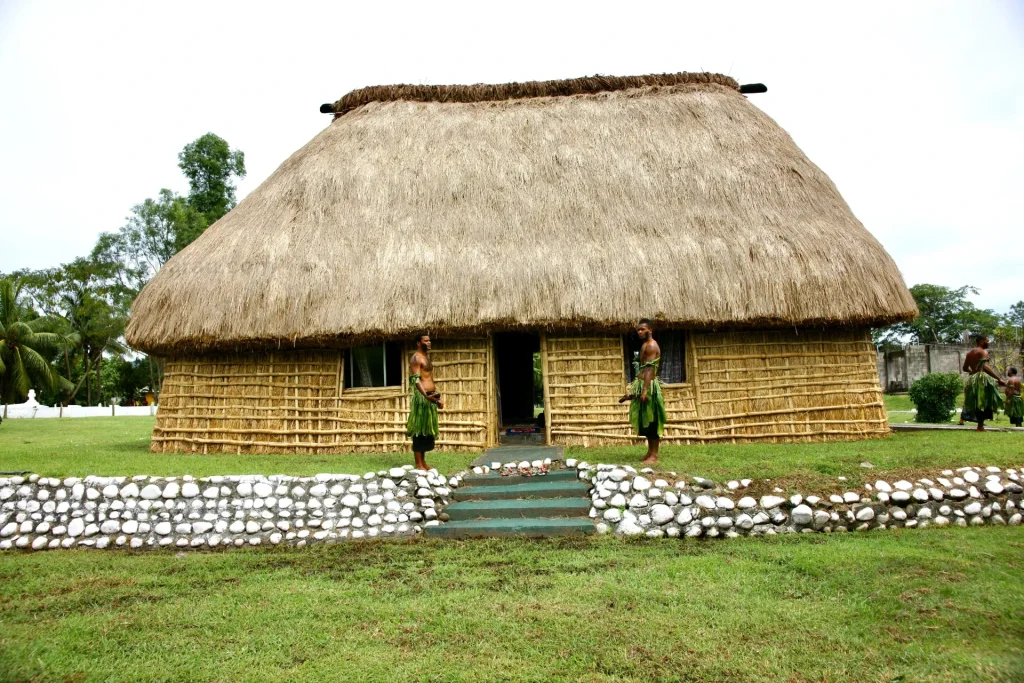
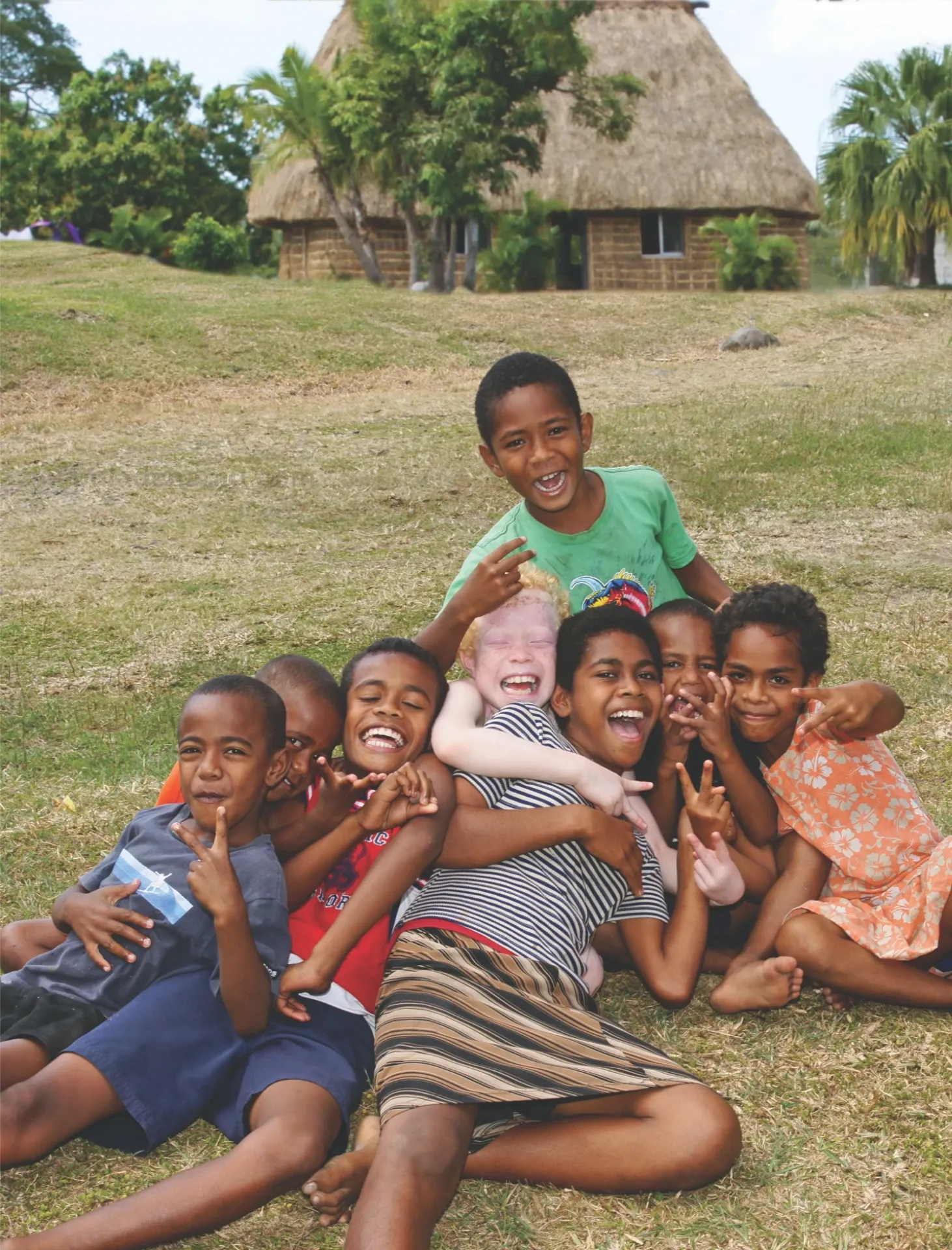
Bure versus Vale. The warriors are guarding an important ceremonial meeting in the Tui’s or King’s Bure. This structure stands on the precise, traditional site where the Tui’s bure has stood for hundreds of years; as the natural materials age and wear, the building is respectfully knocked down and rebuilt upon the same sacred ancestral foundation. While popular culture often misinforms visitors by calling any house or hut styled this way a bure, traditionally a bure served strictly as a men’s sleeping/meeting house or a sacred temple, whereas normal residential family houses are known as vale. Understanding these types of structural boundaries is the first step in approaching a traditional iTaukei community with genuine respect.
Village Visits and Village Etiquette Guide, either as part of a Tour or by yourself.
In Fiji, as in other countries, it is wise to be both considerate and respectful of the local culture and follow proper Fiji village etiquette. Fijian people are legendary throughout the world for their friendliness and hospitality. This is one of the outstanding attractions of the country and becomes immediately obvious from the reaction of locals from the moment you enter the arrivals hall.
Visitors to Fiji are regarded as honoured guests and overwhelmed with hospitality. Such legendary friendliness is a part of a rich cultural heritage.
It would be unthinkable for a Fijian to sit down to a meal and, should you be in the vicinity, not to invite you to partake. Similarly villagers will gladly give up their chores to welcome strangers, mix up a brew of yaqona or kava or a cup of tea or glass of juice, and sit around and talanoa or chat – quizzing the visitors to satisfy their curiosity.
The Adventure of Doing It Yourself.
There is a proper form to observe when entering villages and in dealings with people. There are lots of tours that offer organised village visits and they are great. They can offer you things that you cannot find or are difficult to find on your own. They are well organised and fun.
But if you are feeling adventurous and wish to, you can have a crack yourself. It’ll likely turn out to be the most unique adventure and probably the highlight of your trip! Villages (koros) are everywhere. Get in a car or taxi and drive from your resort, it will not take long before you will find yourself in the middle of one, as the main roads run by or through them.
Preparation and your Sevusevu.
A sevusevu is far more than just a gift of kava; it is the formal protocol of respect that bridges the gap between a visitor and a host. In the eyes of a village, the sevusevu is the “key” to the community.
The word itself is rooted in the tradition of sevu, meaning to present the first or most valuable portion of something. In this context, your sevusevu is the instrument of that tradition—your sevusevu signals that you recognize the community’s stewardship and wish to enter as an honored guest rather than a stranger.
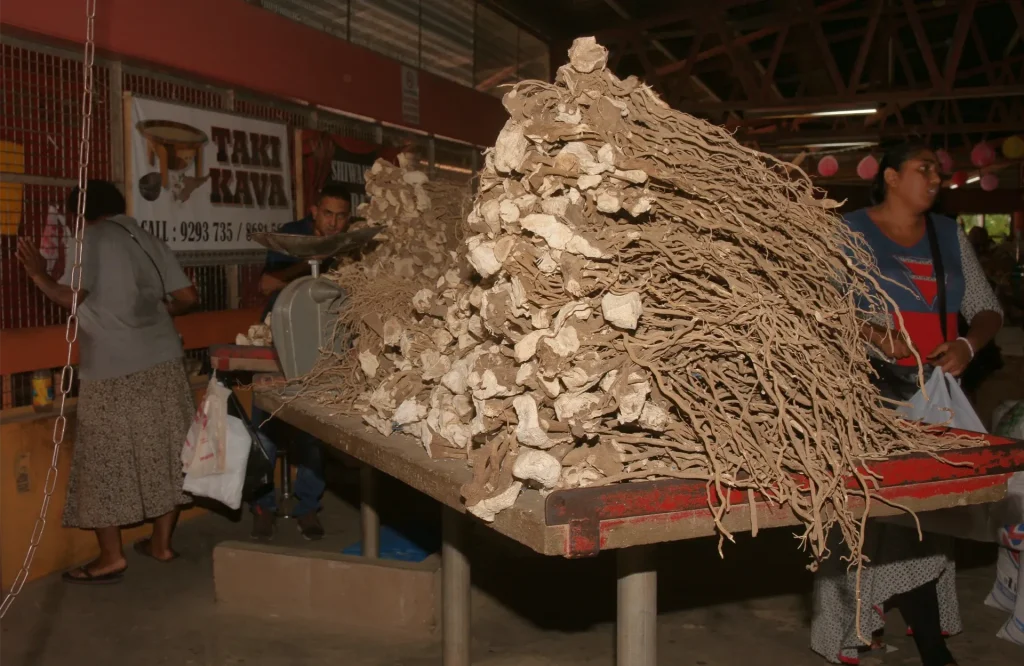
First things first. You will need to get your sevusevu. You will need half or one kilogram of dried kava roots, known locally as yaqona. It is pronounced yangonna. If you are going for an authentic experience, start calling kava yangonna.
To get your yaqona, you will need to take a trip to your local market. Pop into the market and tell the market vendor that you wish to present a sevusevu and want good waka. Good waka is the finest root of the plant and makes the strongest brew – hence, they are the most valuable and respectful offering. The market vendor will prepare it for you accordingly. One kilogram is a good amount, but half a kilogram will do.
Perhaps get your sevusevu in advance as part of a trip to the local market and town. It does not spoil, so you can keep it in your resort room. The vendor will wrap it in newspaper and tie it with string. Check out the photos to see waka roots in a market.
Finding a Village and Engaging with the Turaga ni koro.
The next step is to find a village or koro. No problem there. The main roads of Fiji run through many villages. If that is a bit vague, you can always talk to staff at your Resort, particularly if you have already struck up a friendship. They will have recommendations, including possibly taking you home if their village is nearby.
What to do when you get to the village. When entering a village, tell the first person you come across that you wish to see the Turaga (pronounced Turannga) ni koro to present him with your sevusevu. The Turaga ni koro is the village administrative headman. You will be taken to him or taken to a place where you are to wait for him.
Sit cross-legged on the floor in front of him or waiting for him if you are a man, or with your knees bent and legs to the back side of you if you are a woman.
Presenting your sevusevu. When he comes, he will sit cross-legged opposite you. If you have family/people with you, have them sit behind you with your sevusevu by your side. Introduce yourself and your party and tell him you wish to present him with a sevusevu.
Formal protocol. The presentation of a sevusevu is a formal affair, and there is a proper protocol to be followed. And so it is normal that he will take over proceedings. It is most likely he will call someone to present the sevusevu on your behalf. Strictly speaking, certain specific clan members are the people required to perform the sevusevu. Don’t sweat it. Visitors are welcome – and you will be taken care of. The presentation of your sevusevu is the necessary thing to do and highly respectful. It will be received accordingly.
Is it rude to take photos in a Fijian village? No — but always ask permission first. Photography is welcome once you’ve been formally welcomed, and the same courtesy applies to walking around and speaking with people.
After the sevusevu has been presented, you may engage in general conversation with him. He is likely to ask you where you are from and things like that. When you feel the time is right, tell him you would like to request permission to look around the village, take snapshots, and talk to people. He may or may not assign someone to show you around. If you would like to drink a small mix of yaqona, make that request also.
Gift Giving: What to bring: clothes, school supplies, or groceries — and a little candy!
It is always a great idea to bring some gifts with you. Most people focus on the children, don’t we all! But don’t forget the mums. You can make it part of your pre-trip planning to visit secondhand or thrift shops and stock up a little.
- Clothes are always a winner – shirts, pants, and shoes of all sizes will be most welcome. You can find second-hand clothes stores in towns.
- For mums’ bras (big and oversized can be hard to find here, but all sizes) and panties, followed by skirts, tops, and dresses.
- Also, school supplies. While Fijians value education very highly, many families struggle with providing the basics. But here is the trick, many people lug school books, pens, pencils, etc with them. Firstly, stationery supplies are heavy, and you can get them cheaply and easily here. Get to a Post Fiji shop, and you can get everything there.
- But clever items like early math and English books, sentence structure, comprehension, and number matching and basic addition that are taken for granted overseas are not readily available here. And when they are, they are not readily available to most students. I would concentrate on those sorts of items. If you visit a school, perhaps talk to the school about them taking them apart and copying them for general use. I
- f you have a few special books for the school library, awesome.
- If clothes or school supplies aren’t available, or if you prefer, go to a supermarket in town or a local rural shop, and get some groceries – 10kg of flour, 10kg of sugar, some tea, and a big bucket or two of breakfast crackers will do the trick.
- Present the items with the yaqona sevusevu to the Turaga ni koro. If you have gifts, tell him that you do. Whatever gifts you give will be very much appreciated. It is the thought that counts, and the bigger the thought, the more it counts!
- And of course, there is always room for a little candy!
Dress Codes and Cultural Nuance.
- Fijians observe a strict dress code. Women need to ensure that their shoulders and knees are covered. For both men and women, a T-shirt is fine, or for women, a dress is best. Loose-fitting rather than tight-fitting clothes are appropriate. For women, if you are planning a village visit, a simple solution is to buy a wrap-around, or sulu, from your resort’s convenience store or in town. They are easy to use and appropriate. Just wrap it around your waist and tie it in the middle or on the side. For your top half, dress conservatively.
- It is not okay to wear a hat inside a village or inside government or official buildings. The ‘no hat’ rule is a relatively recent addition to Fiji’s contemporary culture, having originated out of traditional ceremonial, and having become a fixed rule through custom and practice.
- Do not touch people on their heads, including children. The reason why it is not allowed to touch people on their heads is as follows. The head – ulu – of all people is considered a collective spiritual sacredness. Only people who fulfill traditional designated roles may touch and dress the head.
- Women: do not bare your shoulders or your knees. This cultural idiosyncrasy arose originally from Christian and Victorian England’s forms of decency. It persists to this day.
- Take off your shoes when entering houses and buildings, and avoid walking between people. If you must move around, walk behind people, not between them, and say tulou (pronounced toolow), which means ‘excuse me,’ as you do so.
Also, do not conduct a village visit on a Sunday unless you wish to attend a church service first, in which case you will be very welcome. If you wish to attend a church service, it would be best to first visit the village during the week to present your sevusevu and to request to do so. In that way, you will find out the necessary details of when and where the service is being held.
Fijians dress for church, and you should do so as well. If you wish to really go for it you can go to town and get a black ‘pocket’ sulu and white shirt for men and boys. Ask the shop keeper how to put the sulu on – these are a little more complicated with a belt and clasp. For women and girls dresses are most appropriate.
Participating in a Kava Ceremony.
If you are invited to drink yaqona:
- Sit where you are told and don’t move around. Never walk in front of the yaqona tanoa; always behind it. That is because the space between the tanoa and those preparing the yaqona and those drinking it is considered sacred. The tanoa is what the yaqona is prepared in. The tanoa faces the people drinking it, with the servers behind it.
- When you are offered your first bilo or cup of yaqona clap your cupped hands once and then take it.
- Say “bula” to all assembled, including your party, and drink the bilo in one draft;
- clap your hands three times after giving the bilo back
- For subsequent rounds just clap once before receiving the bilo and three times after handing it back. Don’t say bula again. Clap with cupped hands.
Final question for you.
Today, everyone has access to petrol-driven grass cutters and steel machetes. That helps explain how the villages are kept looking pristine. But how was it done in an age when these tools were not available? The answer is by plucking the grass by hand and by using sharpened knives of bamboo. The bamboo knives were very useful and versatile, being also used by cannibal kings to have their bakola cut up for them!
Many, many special lifelong friendships are forged between visitors to Fiji and locals. As that happens you feel yourself moving from being a visitor to part of the family. That’s why we say you have become part of the Denarau and Fiji family – village visit or no village visit!
To be even better prepared for your visit learn more about Fiji’s language, people, culture, history, and settlement. Our highest recommendation for the best and most genuine village visit is here. For more insights on local traditions, explore our complete guide to Fijian Culture, People & Customs.
HTML